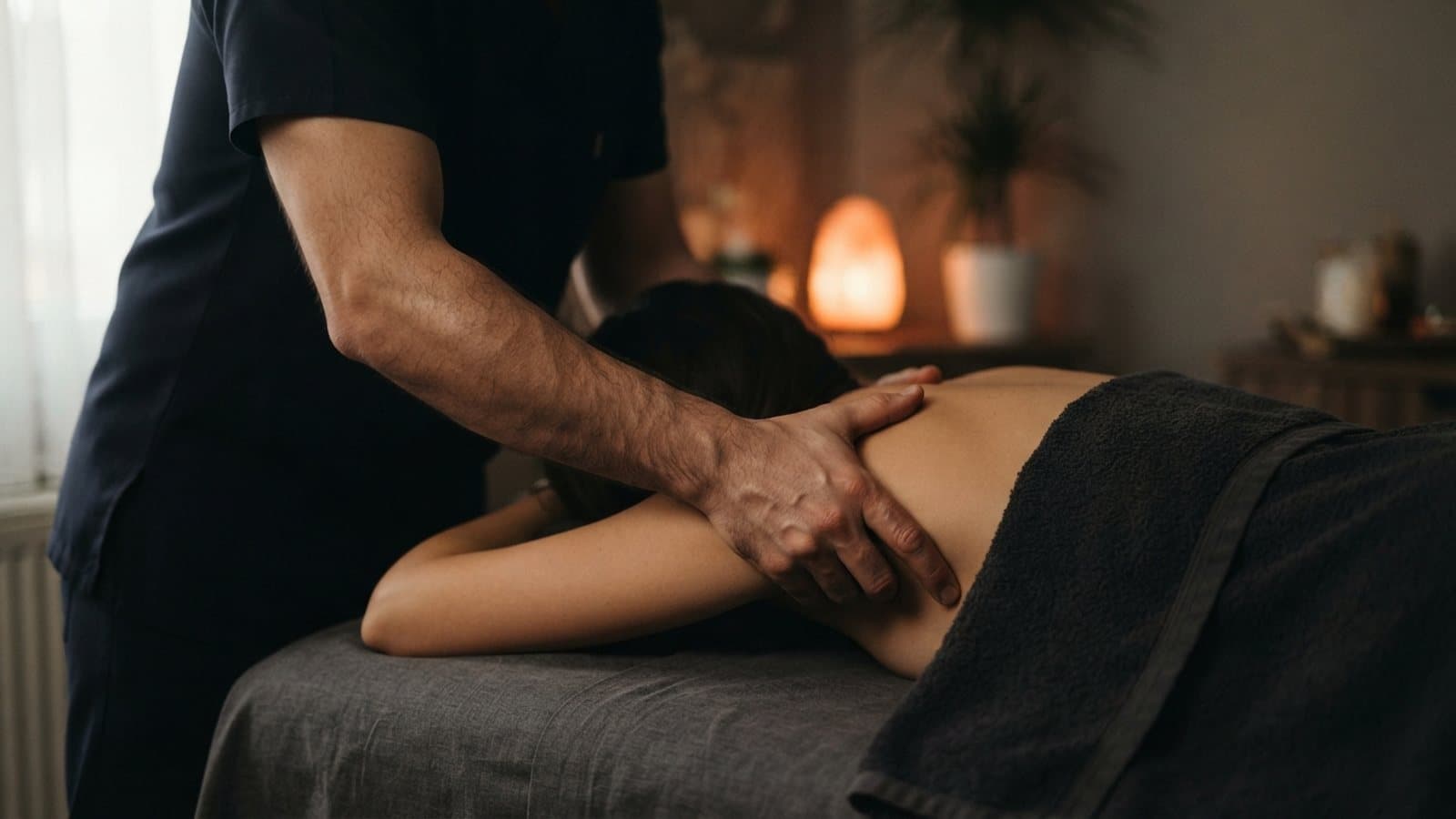
Deep tissue massage is a slower, firmer type that focuses on the deeper layers of muscle and connective tissue. People with muscle tension often choose it, but it can leave you sore afterwards and some health conditions call for a doctor's advice first.
What is deep tissue massage?
Deep tissue massage is a slow, firm-pressure type of massage aimed at the deeper layers of muscles and connective tissue. Cleveland Clinic describes it as a method that works into the depth of muscles and tendons to ease tension, and finds it suitable for people with an injury, general muscle tension or ongoing muscle pain. Stiffness from sitting at a computer for long hours or working hunched forward falls within that scope.
In classic massage the aim is general relaxation with long, flowing strokes, while in deep tissue the therapist makes slower, firmer movements on specific areas. You can see the type's page at deep tissue massage and compare the profiles that offer it there.
| Feature | Classic (Swedish) massage | Deep tissue massage |
|---|---|---|
| Pressure | Light and medium | Medium and firm |
| Focus | General relaxation, full body | Specific muscle groups, tense areas |
| Tempo | Flowing and rhythmic | Slow and focused |
| Afterwards | You may have mild muscle tenderness | Muscle soreness can be more noticeable |
| First-timers | A common starting point | Usually chosen later |
Who might deep tissue massage suit?
Deep tissue massage can be a suitable option for people with ongoing muscle tension in particular areas, people who sit for long periods and people who play sport. Cleveland Clinic lists this type for people with an injury, general muscle tension and ongoing muscle pain. The U.S. National Center for Complementary and Integrative Health (NCCIH) says massage may help with some kinds of pain in the short term, but that the evidence is limited.
- Desk workers: People who feel stiffness in the neck, shoulders and back. For more, see the neck and back massage article.
- People who play sport: Those who want to focus on the muscle groups strained in heavy training. For timing, read the sports massage article.
- People who like firmer pressure: Those who have tried classic massage and found the pressure too light.
Massage does not remove the cause of pain and does not replace care for a health problem. NCCIH says the evidence supporting massage for low back pain is weak, and that the benefit for neck and shoulder pain may be short-lived. If your pain continues, see a doctor.
Who should check with a doctor before deep tissue massage?
In some health conditions you need to check with a doctor before deep tissue massage, because firm pressure can rarely cause serious problems. NCCIH says the risk of harm from massage appears low, but serious side effects such as blood clots, nerve damage or bone fractures have been reported rarely. Most of those cases involved forceful massage such as deep tissue, or people at higher risk of injury, for example older adults.
In the following situations, speak to your doctor before the massage and tell your massage therapist:
- If you have a history of blood clots or take blood thinners
- If your bone density is low or you have had a fracture recently
- If you have had surgery recently (Cleveland Clinic advises getting a doctor's approval for massage after surgery)
- If you are pregnant (pressure should be light or medium in pregnancy, and deep pressure should not be applied)
- If you have a fever, a skin infection or an open wound
How is the pressure set in deep tissue massage?
You set the pressure; at the start and during the session, give your therapist feedback by saying "lighter", "medium" or "firm". Deep tissue can bring some discomfort, but it should not turn into sharp or unbearable pain. A therapist quoted by Cleveland Clinic says that if a technique is not doing you good and is only causing pain, it should be talked about.
There is no rule that says the harder it is, the better. If you are holding your breath, tensing your muscles or your body is tightening, the pressure may be too much. You can use small cues to talk about pressure with your therapist: "a bit lighter", "just right" or "too much" is enough. Reducing the pressure does not mean cutting the session short; it is usually solved by the therapist moving more slowly over the same area. In a first session, starting at medium pressure and increasing it later is safer. You can stop the session whenever you do not feel comfortable; we described how a session goes in the first appointment guide.
What do you feel after deep tissue massage?
Muscle soreness after the session is something to expect, especially with deep tissue massage. Cleveland Clinic says muscle soreness after a massage usually lasts from a few hours up to a day and a half, and that massages that focus on specific muscle groups, such as deep tissue, can cause more soreness.
- Drink water before and after the session.
- Take a light walk and stretch gently.
- Avoid intense training on the first day.
- A warm shower or a warm compress wrapped in a towel can help relax your muscles.
If severe pain lasts longer than a few days, or signs such as bruising, numbness or dizziness come with it, see a health professional. For aftercare tips, see the aftercare article.
How should you start if it is your first deep tissue massage?
If you are trying deep tissue massage for the first time, the safe route is to progress gradually. Starting the first session at medium pressure and increasing it if you are comfortable lets you see how your body responds. Before the session, tell your therapist where you feel tension, how long it has lasted and whether you have had a massage before. Drink water before the session and try not to go in on an empty or a full stomach.
Because there can be muscle soreness afterwards, it makes sense to put the first session on a day when you do not have a heavy schedule the next day. If you will focus on one area, a short session may be enough; for several areas you can consider a 60-minute session. Decide with your therapist which suits you. Even so, if pain in the same area lasts a long time, see a doctor instead of waiting for the massage.
How do you choose a therapist for deep tissue massage, and how long should it be?
It is important to ask about your therapist's training and experience. NCCIH recommends asking about the therapist's training, experience and credentials, and talking about the number of sessions and the cost up front. For deep tissue most people find a 60-minute session enough; for help choosing a length, see the article on 30, 60 and 90 minute sessions.
On Masöz, badges rest on the editorial team's review, not on user comments; you can read the criteria on the How We Verify page. The price is stated on each profile, and we explained the factors in the article on massage prices in Istanbul. Masöz is not an intermediary; pay in person at the time of the service.
Sources
- Massage Therapy: What You Need To Know, NCCIH, U.S. National Institutes of Health (2019-05). Accessed: October 10, 2026
- Massage Therapy for Health: What the Science Says, NCCIH, U.S. National Institutes of Health (2018-12). Accessed: October 10, 2026
- Types of Massage Therapy to Try, Cleveland Clinic (2021-04). Accessed: October 10, 2026
- Why Do I Feel Sore After a Massage?, Cleveland Clinic (2024-02). Accessed: October 10, 2026
- Prenatal Massage: Benefits, Types and What To Expect, Cleveland Clinic (2025-09). Accessed: October 10, 2026
Frequently Asked Questions
What is the difference between deep tissue and classic massage?
Classic massage uses light and medium pressure for general relaxation, while deep tissue uses slower, firmer pressure to target specific muscle groups. Classic massage is a common starting point for first-timers.
Does deep tissue massage hurt?
You may feel some discomfort, but there should be no sharp or unbearable pain. You can tell your therapist whether you want light, medium or firm pressure; say so right away if you feel pain.
How long does muscle soreness last after deep tissue massage?
According to Cleveland Clinic, soreness after a massage usually lasts from a few hours up to a day and a half. It can be more noticeable after deep tissue massage. If severe pain lasts longer than a few days, see a health professional.
Who should not have deep tissue massage?
If you have a history of blood clots, take blood thinners, have a bone health problem, recent surgery, a pregnancy, a fever, a skin infection or an open wound, you need to check with a doctor first. Deep pressure is not applied in pregnancy.
How many minutes should a deep tissue massage last?
60 minutes is enough for most people. If you want to focus on one area, 30 minutes may also suit. Decide the length with your therapist according to your needs.
Related Pages
Editorial team
Masöz editorial team
The Masöz editorial team prepares the guide articles, checks them together with their sources and keeps them up to date. The articles are for information only and are not a substitute for medical advice.
All articles by this authorThis article was translated from the Turkish original and checked by our editor.