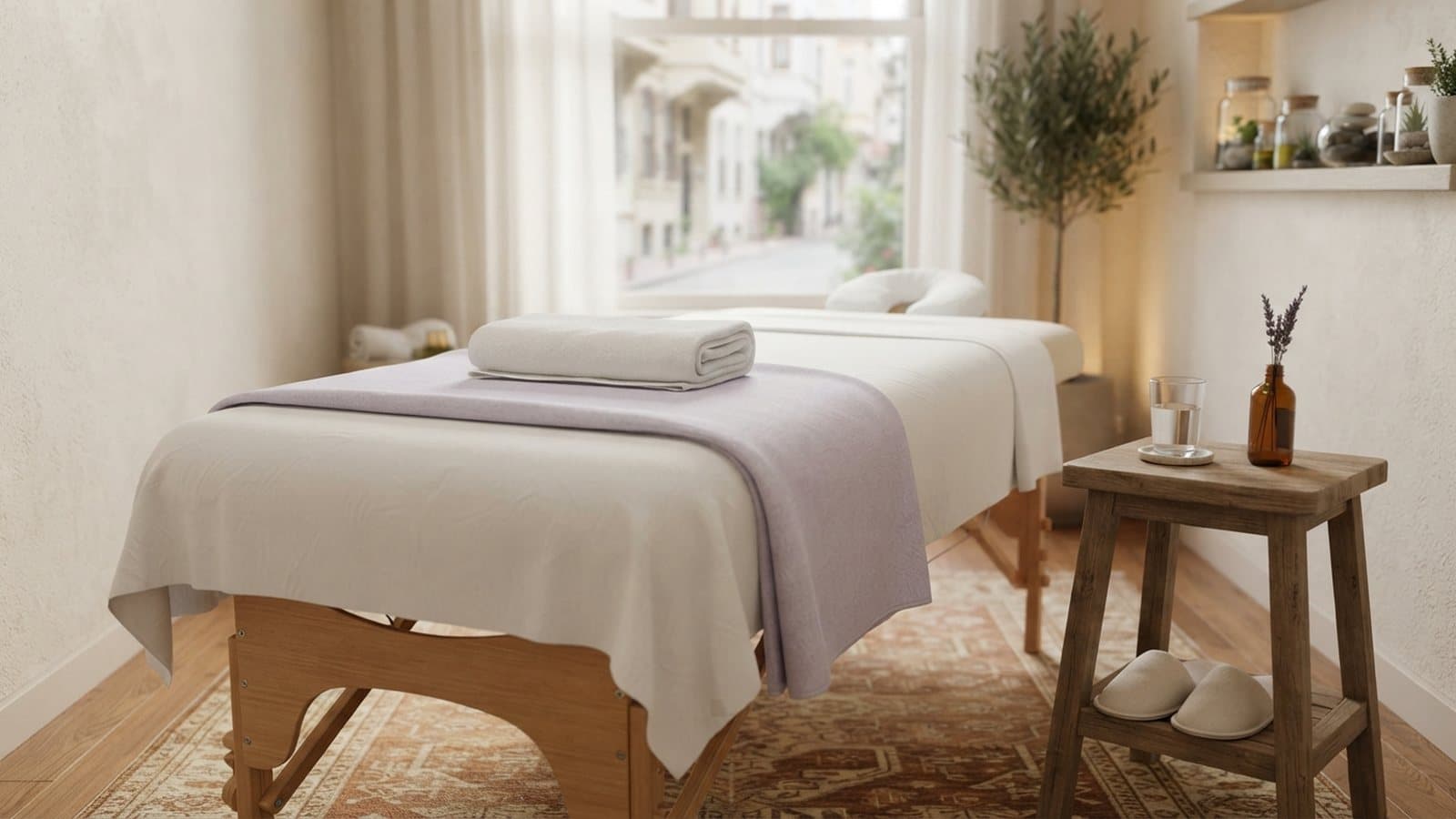
At a first appointment you can expect a short introductory chat, questions about pressure and the areas to work on, a session with towels or a sheet covering you, and a short rest afterwards. Saying plainly how much pressure you want, noticing hygiene and choosing a therapist with badges can all improve the experience.
What should you do before your first massage appointment?
Coming prepared makes the session more comfortable, and a few simple steps before the appointment are enough. The table below works as a checklist.
| Preparation | Why it matters |
|---|---|
| Be ready 10 to 15 minutes early | It is harder to relax when a session starts in a rush |
| Eat something light instead of a heavy meal, and drink water | Arriving full or dehydrated can make the session uncomfortable |
| Choose comfortable clothes that are easy to take off | You can get ready slowly after the session |
| Confirm the length, massage type and price in advance | No misunderstandings on the day of the session |
| Have your health condition, medication and allergies ready | The therapist adjusts the session to you |
| Make sure no deposit or advance payment is requested | Payment is made in person at the time of the service |
The price is stated on each therapist's own profile; we explained how prices come about in the article on massage prices in Istanbul. If you are not sure which therapist to talk to, you can start from the Istanbul massage therapists guide and look through the profiles by your district and your needs.
How does the first session go?
The session starts with the therapist welcoming you and a short introductory chat. The American Massage Therapy Association (AMTA) says the therapist asks preliminary questions about your health history, medication, pain and stress and shapes the session around your goals. Table sessions usually last between 30 and 90 minutes.
| Stage | Approximate time | What happens |
|---|---|---|
| Welcome and chat | 5 minutes | The therapist asks about your expectations, the areas where you feel tension and any health notes |
| Preparation | 2 to 3 minutes | The therapist leaves the room; you undress as far as you are comfortable and lie under the sheet |
| Massage | 45 to 50 minutes | Only the area being worked on is uncovered and the rest stays covered; the therapist asks about pressure |
| Finishing | 2 to 3 minutes | The therapist leaves the room and you get up slowly and dress |
| Short conversation | 2 to 3 minutes | You say how you feel, have some water and talk about next steps |
These times are examples and vary from therapist to therapist. Ask in advance whether the session length includes preparation time; for example, if the welcome and undressing are part of a 60-minute appointment, the actual massage time is shorter. We explained the difference in detail in the article on 30, 60 and 90 minute sessions.
The U.S. National Center for Complementary and Integrative Health (NCCIH) describes Swedish, or classic, massage as the most common form of massage in the West. Starting with classic massage or Swedish massage is common for first-timers. For the differences between types, see the classic (Swedish) massage article.
How do you tell the therapist the pressure you want?
Say plainly at the start and during the session whether you want light, medium or firm pressure; people perceive pressure very differently. Do not hesitate to talk about:
- The level of pressure
- Areas that are sensitive or uncomfortable for you
- Preferences such as room temperature, lighting and music
- That you will say right away if you feel any discomfort
Giving feedback is not rude; it is part of the service. AMTA says the therapist should check your pressure and comfort throughout the session and that you can ask for a change at any time. If you want firmer pressure, the deep tissue article explains the difference.
What should hygiene and comfort look like?
Clean, fresh linen, regularly cleaned surfaces and an oil or lotion suited to your skin are the expected standards. You can look at the setting before the session begins and ask your questions. If you are allergic to a product, say so beforehand.
Comfort matters as much as hygiene. According to AMTA, the drape covers the areas not being worked on, and you undress only as far as you are comfortable. You have the right to stop the session or change direction at any moment when you do not feel comfortable.
What can you expect after the session?
Lying still for a minute or two, then getting up slowly and drinking water is a good start. Cleveland Clinic says that aching or stiff muscles after a massage are normal, especially if you have not had a massage for a long time or this is your first, and that the discomfort usually lasts from a few hours up to a day and a half. The same source recommends drinking water before and after a massage.
If severe pain lasts longer than a few days, see a health professional. It helps to note down what the therapist recommends after the session, for example which area to look after or how long to wait before the next one. Massage is a service for relaxation and does not replace care for a health problem; if your complaint continues, have it assessed by a doctor. Detailed recommendations are in the aftercare article.
What are the most common mistakes at a first appointment?
Most mistakes at a first appointment come from a lack of communication, so a little preparation prevents most of them.
- Not mentioning the pressure: If firm pressure bothers you but you stay silent, the session is not enjoyable. Say so right away.
- Not sharing health information: Do not keep your medication, past surgeries and allergies from the therapist. The therapist adjusts the session accordingly.
- Arriving too late: It is harder for your muscles to relax in a session that starts in a rush.
- Not asking about length and price: Not settling these up front leads to misunderstandings on the day.
- Rushing into a busy schedule afterwards: Leave yourself a short time to rest after the session.
- Putting up with pain in silence: If you feel pain during the session, saying so is part of the service.
Avoiding these mistakes makes your first experience noticeably more comfortable. If you are still undecided, talking to the therapist by phone beforehand answers most of your questions. In the same call you can ask about the therapist's working arrangements, where the session will take place and how they will contact you on the day.
How do you choose a therapist safely for a first appointment?
Look at the editor badges on the profile, the massage types stated, the working area at district level and the price information. The badges are an editorial review, not user ratings, and the criteria are explained on the How We Verify page.
NCCIH also recommends asking about the therapist's training, experience and credentials. Location is shown only at district level; no full address is published on any profile.
How do you get in touch with a therapist on Masöz?
You find a profile by district, need and massage type, and talk to the therapist directly by phone or WhatsApp. Masöz is not a booking or payment intermediary; it is a guide with no intermediary, and no payment is taken through the platform.
Pay in person at the time of the service. If you meet a profile that asks for a deposit, an advance payment or a "travel fee" before the session, tell us through the Report a Violation page. We collected the signs of fake listings in the article on massage scams and fake listings.
Sources
- Massage Therapy: What You Need To Know, NCCIH, U.S. National Institutes of Health (2019-05). Accessed: October 10, 2026
- Everything You Need to Know About Massage Therapy, Cleveland Clinic (2021-11). Accessed: October 10, 2026
- Why Do I Feel Sore After a Massage?, Cleveland Clinic (2024-02). Accessed: October 10, 2026
- Prenatal Massage: Benefits, Types and What To Expect, Cleveland Clinic (2025-09). Accessed: October 10, 2026
- What to Expect at Your Massage Session, American Massage Therapy Association (AMTA). Accessed: October 10, 2026
Frequently Asked Questions
What should I do before my first massage appointment?
Be ready 10 to 15 minutes early, eat something light and do not go without water, and choose comfortable clothes. If you are pregnant or have a chronic condition, recent surgery or regular medication, speak to your doctor first and tell your therapist.
How do I tell the therapist how much pressure I want?
At the start and during the session, say plainly whether you want light, medium or firm pressure. You can say right away when you feel any discomfort; feedback is part of the service.
Which massage type suits first-timers?
Classic (Swedish) massage is the most common starting point. If you want firmer pressure, you can look at deep tissue massage later. If you cannot decide, it is enough to tell the therapist how you feel.
How do I book and pay through Masöz?
Masöz is a guide with no intermediary; no payment or booking is made through the platform. You talk to the therapist directly by the phone number or WhatsApp on the profile and agree on the details yourself. Pay in person at the time of the service.
Is it normal for my muscles to ache after a massage?
According to Cleveland Clinic, aching or stiff muscles after a massage are normal, especially after a first session, and usually last from a few hours up to a day and a half. If severe pain lasts longer than a few days, see a health professional.
Related Pages
Editorial team
Masöz editorial team
The Masöz editorial team prepares the guide articles, checks them together with their sources and keeps them up to date. The articles are for information only and are not a substitute for medical advice.
All articles by this authorThis article was translated from the Turkish original and checked by our editor.